Gardening tips
Feeding ficus and palms
Ficus and palms are large, long-lived plants that sit in the same tub for years. We look at what to feed them, why the solution often does not reach the roots, and which leaf problems have nothing to do with fertiliser.
What ficus and palms have in common
Both plants are valued for their leaves, both grow for years in one large tub, and both go hungry quietly and for a long time. Soil in a tub does not replenish itself, and every watering carries part of the nutrient salts out into the saucer. After two or three years without feeding the plant is still alive and green, but clearly “fading”: new leaves are smaller than the old ones, and the crown thins out.
The differences start with the formula and the pace. Ficus grows fast and constantly adds leaves — it needs nitrogen. A palm grows slowly, and what matters to it is not only growth but also a working root system, because it is repotted rarely. That is why the “Mister Tsvit” line has two different bottles for them.
Ficus and foliage plants
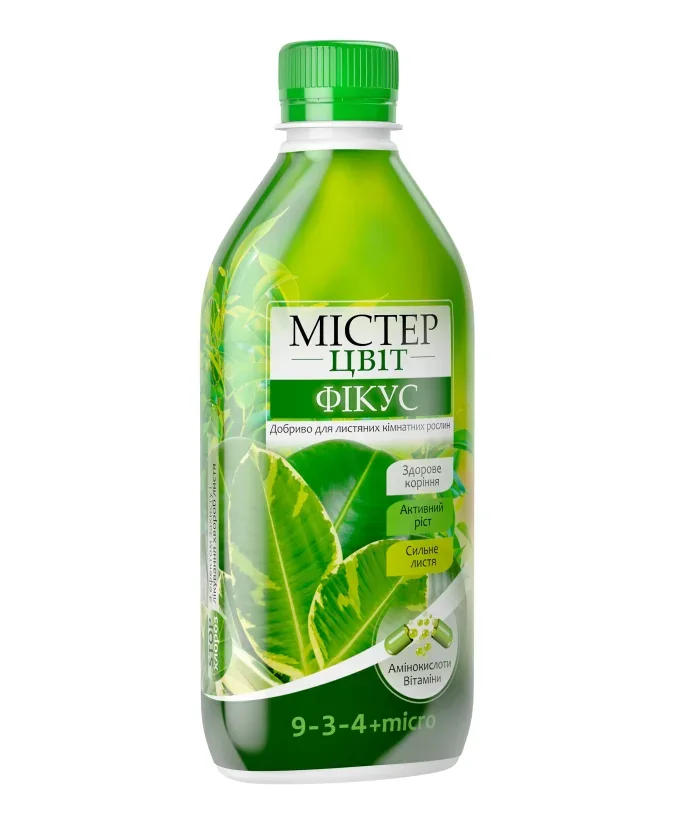
“Mister Tsvit Ficus” is a fertiliser for foliage houseplants with NPK 9-3-4 and micronutrients. It has the highest nitrogen in the line: in ficus, monstera, dracaena, schefflera or ZZ plant the value is precisely in the leaves — their size, density and colour. Nitrogen builds green mass, while phosphorus, which works for buds, is deliberately reduced here.
How a ficus shows hunger
- the lowest leaves turn yellow and drop — one at a time, without spots and without webbing;
- the trunk gradually becomes bare, and the crown “moves” to the top;
- new leaves come out noticeably smaller than last year;
- variegated varieties — a weeping fig or a rubber plant with a light pattern — lose their pattern and turn green: the light part of the leaf is the most expensive to maintain, and the plant cuts it first.
In dracaena and yucca the same story can be read from the lower leaves, which dry out faster than new ones grow.
Season
Feed from March to September, when the ficus is actually growing. In autumn and winter, if the plant stands deep inside the room, feeding is stopped: without light, nitrogen produces weak, stretched shoots. Variegated varieties need bright light all year round — without it nitrogen will give not a pattern but pale, stretched branches.
Palms and ferns
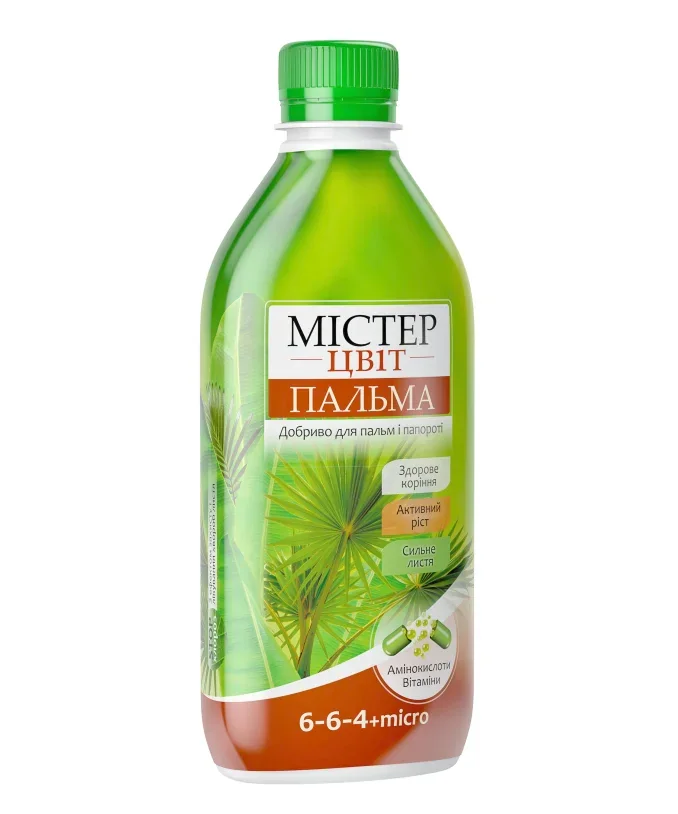
“Mister Tsvit Palm” — the label says “fertiliser for palms and ferns”, NPK 6-6-4 with micronutrients. Nitrogen and phosphorus are equal, potassium slightly lower. The equal phosphorus is no accident: a palm needs both leaves and healthy roots, because it is repotted once every few years, and between repottings there is nothing for it to feed on. This fertiliser is also suitable for dracaena and yucca — they are in the line's description too, so for these plants you can choose either of the two bottles, depending on what you already have on the windowsill.
How a palm shows hunger
- each new frond comes out shorter and narrower than the previous one;
- not a few weeks but many months pass between new leaves;
- the lower leaves turn completely yellow and dry out faster than new ones grow, and the crown thins out.
In a fern the picture is different: the fronds turn pale, the plant loses density in the centre and spreads out at the edges. Unlike a palm, a fern does not like drying out between waterings: on a dry substrate it curls its fronds, and the feeding is wasted.
Season
Palms are fed in the warm season, from March to September. In winter — only if the plant stands in a bright place and keeps growing.
A large tub: how to get the solution to the roots
This is the main practical problem with large plants, and it is the reason feeding often “does not work”. In a large tub the root ball can be dry inside even when the top is moist. A glass of solution poured into the centre wets only the top layer, where there are almost no roots.
- First water the plant with plain water — on moist soil the solution spreads more evenly and does not burn the fine roots.
- Prepare enough solution according to the label: for a large tub, not a glass but a full watering volume.
- Pour in a circle near the wall of the pot, in several passes, until the solution starts to appear in the saucer.
- After half an hour, pour off the excess from the saucer.
Every few months it is useful to flush the tub with plenty of clean water to wash out accumulated salts, and to remove the white crust from the soil surface and replace it with fresh substrate. The dose for both bottles is on the label; the concentrate is measured with the cap.
When not to feed
- Right after repotting — fresh soil contains nutrients. Give a ficus two to three weeks, a palm three to four.
- A plant under stress. A weeping fig that drops leaves by the handful after being moved, a draught or cold watering is not hungry — it is reacting to changed conditions. Fertiliser will only add to the load.
- In a dark corner in winter. Without light, nitrogen goes into stretched shoots. More details — in the article should you feed houseplants in winter.
- “To finally get it going.” A palm grows slowly by nature. A higher dose will not speed it up, and washing excess salts out of a large tub takes a long time. Signs and rescue — in the article on overfeeding.
What has nothing to do with fertiliser
- Dry brown tips on palm, dracaena or ficus leaves — most often dry air near a radiator, a dried-out root ball or hard water. Tips that have already dried will not turn green again; they can be carefully trimmed, leaving a thin strip of dry tissue.
- Mass leaf drop in a weeping fig — being moved, a draught from the balcony door, cold water, a cold floor under the pot.
- Sticky residue and scales on the trunk and leaves — scale insects; tiny light dots and fine webbing — spider mites. These are pests, and they need to be treated.
- Black soft spots at the base of the trunk — overwatering and rot.
In short
- Ficus, monstera and other foliage plants — a high-nitrogen formula, from March to September.
- Palms and ferns — equal nitrogen and phosphorus, in the warm season.
- In a large tub there should be enough solution for it to reach the saucer.
- Do not feed after repotting, under stress, or in winter without light.