Gardening tips
Autumn fertiliser for roses: what to feed before winter
In short: in autumn a rose needs phosphorus and potassium with almost no nitrogen. The rate is 25 g per bush, 60 g per large mature bush, in September or early October.
How autumn fertiliser differs from summer fertiliser
Summer fertiliser works on buds and colour. Autumn fertiliser has a different job: to help shoots ripen and roots strengthen before the frosts. The main danger in autumn is nitrogen. It drives soft young shoots that have no time to harden and are the first to die in the frost.
That is why you can recognise an autumn fertiliser by the figures on the pack: the first number is low, the second and third are high. If you are not sure what these figures mean, see the article on NPK.
| Fertiliser | NPK | What the rose gets |
|---|---|---|
| Bright Flowerbed | 14-17-18 | buds and colour, spring and summer |
| Golden Autumn | 6-25-27 | roots and getting ready for winter |
Do not use the summer formula in autumn: it has more than twice the nitrogen, and nitrogen only gets in the way now.
How much to apply: per bush and for the whole plot
The rate of “Golden Autumn” is 25 g (1 scoop) per bush, 60 g per large mature bush. From this it is easy to work out how much you need:
| Pack size | Regular bushes at 25 g | Large bushes at 60 g |
|---|---|---|
| 500 g pack | 20 | 8 |
| 5 kg bucket | 200 | 83 |
| 10 kg bucket | 400 | 166 |
For a few bushes in a garden a 500 g pack is enough. A bucket makes sense if you feed the whole garden: the same formula works for other plants too. To work out your plot, see the article how much fertiliser a plot needs.
How to apply it under a rose
- Water the soil if it is dry. Granules are spread over moist soil.
- Spread the rate evenly around the bush, not right at the base of the stem.
- If you can, gently mix the granules into the top layer of soil so as not to damage the surface roots.
- Keep the granules off wet above-ground parts of the plant.
- Water again if no rain is expected soon.
Wear gloves, and wash your hands afterwards.
When to apply it, and is November too late
The best time is from September to early October, while roots are still active in warm soil. In November, in most regions, the granules no longer have time to do what they are applied for. Once the soil has frozen, the root takes up nothing and the fertiliser just lies there until spring.
If you missed the window, no harm is done. Do not try to make up for it with a double rate; start the season with a regular feed in spring. When, what and how much to give through the year is described in the article feeding roses through the season.
What else to do in autumn besides fertilising
- Do not prune roses hard in September: this also triggers new growth.
- Stop cutting flowers at the end of the season. When a bush forms a few hips, it moves into dormancy faster.
- Do not give nitrogen fertilisers, including manure and humus, right before winter.
Roses in pots and containers
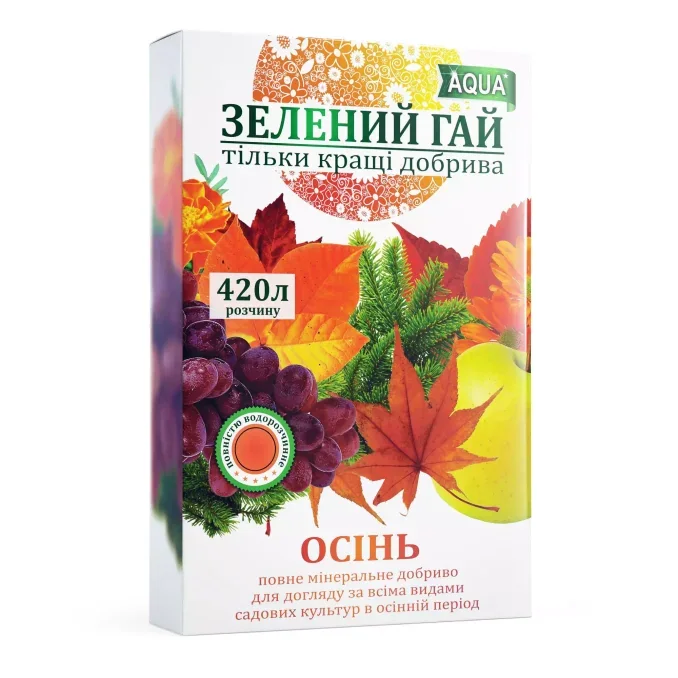
Granules are not used in containers: in a small volume of soil the salts do not wash down, and the roots burn easily. For pots, water-soluble Aqua Autumn is a better fit: dilute it to the ratio on the pack and water it onto moist soil.